Your Cart
Your Cart is Empty
Shop Now
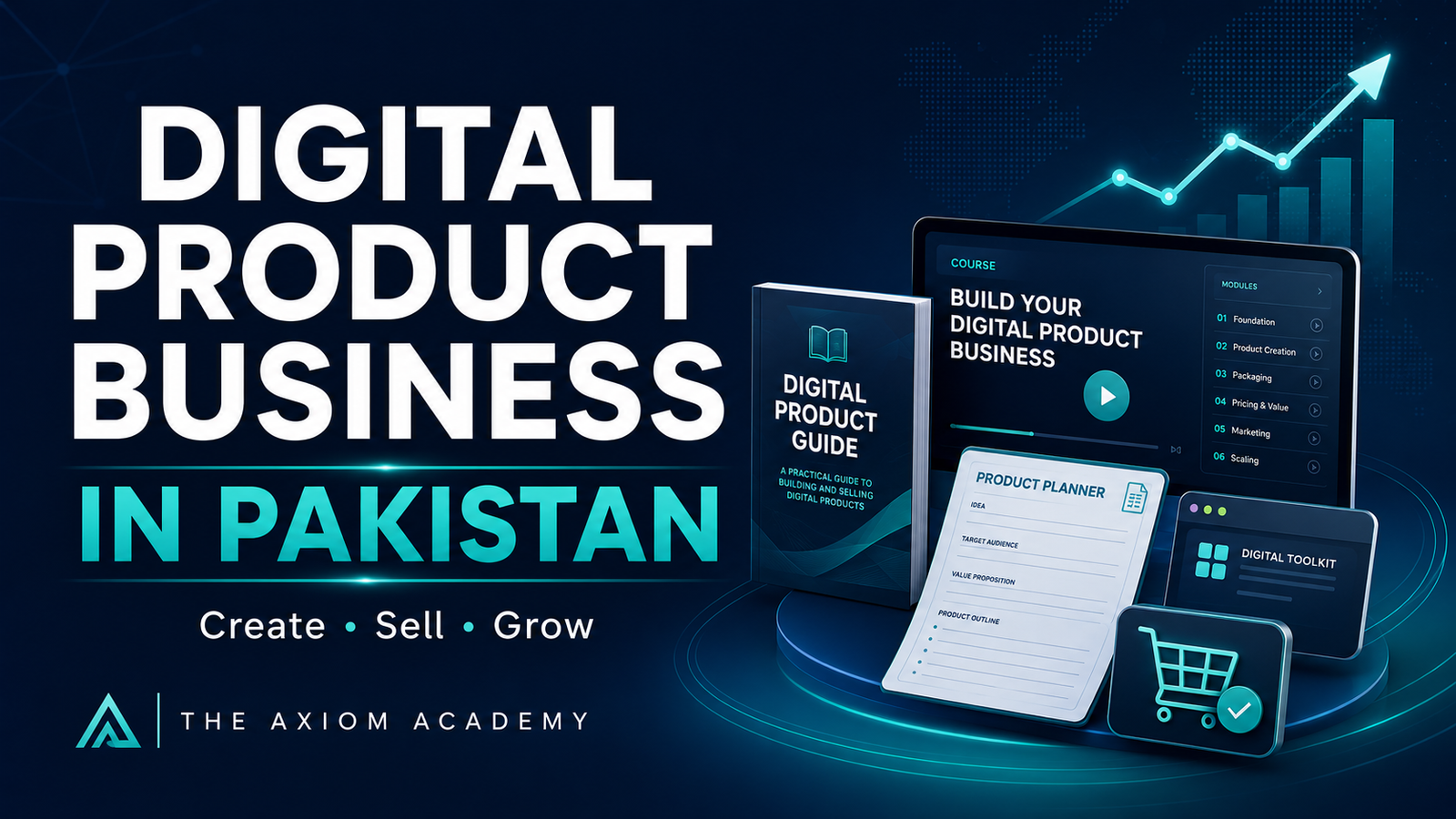
Do you have knowledge, professional experience or a useful skill that could help other people? The Digital Product Business in Pakistan course by The Axiom Academy will teach you how to turn what you already know into valuable digital products and sell them online.
This practical course is designed for teachers, students, working professionals, freelancers and educated homemakers who want to create an additional source of income while continuing their jobs, studies, businesses or household responsibilities.
You will learn the complete process of building a digital product business—from finding a profitable idea and understanding your customers to creating, storing, selling and marketing your product.
No previous business, design, marketing or technical experience is required. You will learn the process step by step using beginner-friendly tools and practical activities.
A digital product business involves creating and selling products that customers can access electronically. Unlike physical products, digital products do not require manufacturing, inventory, packaging or courier delivery.
Common digital products include:
eBooks and practical guides
Online courses and recorded workshops
Worksheets and workbooks
Templates and planners
Study notes and practice material
Educational resources
Digital art and printables
Website themes and plugins
Mobile apps and digital tools
AI tools and agents
Memberships and resource libraries
A digital product can usually be created once and sold to multiple customers. This makes it a scalable business model for people who want to generate side income from their knowledge.
However, digital product income is not completely passive. Creating a valuable product, reaching the right customers, updating your content and providing customer support still require consistent effort. This course will help you build a realistic and manageable system.
Starting a traditional business may require substantial investment, inventory, office space and delivery arrangements. A digital product business can often be started with a smaller budget and managed from home.
Starting a digital product business in Pakistan can help you:
Build a side income from your existing knowledge
Work from home or during your free time
Start without maintaining physical inventory
Avoid packaging and courier delivery
Reach local and international customers
Build a professional online brand
Automate payments and product delivery
Continue your current job, studies or family responsibilities
Create products that can be sold repeatedly
Test a business idea without a large initial investment
The course will show you how to build this business according to your skills, available time, target market and resources.
Begin by understanding what digital products are, how they work and how they can generate income.
Understand the difference between digital, physical and service-based products. Learn how customers purchase, access and use digital products online.
Explore different product categories, including eBooks, courses, templates, planners, worksheets, educational notes, apps, AI tools, memberships and downloadable resources.
Learn about the benefits of low startup costs, flexible working hours, automated delivery, worldwide access and selling one product to multiple customers.
Understand the realistic challenges, including competition, platform fees, content piracy, changing market demand, marketing requirements and customer support.
Learn why digital products can create scalable and partly automated income, but still require research, marketing, product updates and business management.
By the end of this module, you will understand how the digital product business model works and whether it is suitable for your goals.
A successful digital product starts with a real problem—not simply an attractive design or an interesting idea. In this module, you will learn how to identify what people need before investing your time in creating a product.
Identify the specific person who needs your product, the problem they currently face and the result they want to achieve.
Discover product ideas through frequently asked questions, professional experience, customer requests, personal challenges, existing products and online discussions.
Use relevant Reddit communities to find repeated questions, frustrations, unmet needs and problems people are actively trying to solve.
Study conversations in relevant Facebook groups to discover common questions and challenges without copying content or spamming group members.
Use search suggestions, video topics and audience comments to understand what people are searching for and where they still need help.
Explore Amazon, Etsy, Gumroad and relevant course or digital product platforms. Study product listings, customer reviews, prices, strengths and weaknesses.
Identify existing products that solve similar problems. Learn what competitors do well, what customers dislike and how your product can provide a better or more suitable solution.
Check whether people are searching for a solution, discussing the problem, buying similar products or asking for help before you begin creating.
Create a simple customer profile based on their background, problem, desired result, buying concerns, budget and preferred online platforms.
By the end of this module, you will understand your target customer and identify a problem with genuine market demand.
You do not need to invent something completely new. Your education, professional experience, practical skills, personal knowledge and problems you have already learned to solve can become the foundation of a valuable digital product.
Learn why teachers, students, professionals, freelancers and educated homemakers can all create products based on their individual skills and experience.
Review your education, professional responsibilities, personal interests, practical abilities and frequently requested advice to identify what you can teach or share.
Match what you know with a real problem experienced by your target customers. This connection will help you create something useful instead of producing a product based only on assumptions.
Learn how different professions can be converted into digital product ideas:
Teacher → worksheets, lesson plans, assessments or courses
Student → study planners, beginner guides or skill-based resources
Professional → templates, industry guides, training or toolkits
Homemaker → planners, household systems, recipes or practical guides
Freelancer → proposal templates, client documents or mini-courses
Designer → templates, graphics or downloadable assets
Trainer → recorded workshops, workbooks or learning programmes
Decide whether your idea is best delivered as an eBook, template, workbook, course, video, app, website, membership or another digital format.
Compare your ideas according to customer demand, competition, difficulty, required tools, available time and earning potential.
Choose one manageable product that you can realistically create, test and launch during the course.
By the end of this module, you will use the Profession/Knowledge-to-Product Framework to select one practical digital product idea based on what you know and what your target customers need.
Once you have selected and validated an idea, you will learn how to develop it into a useful and professionally presented product.
Define the problem, proposed solution, target customer, product format, learning outcome and required content.
Collect reliable information, use your own knowledge and organize your material into a clear and logical structure.
Create clear, useful and action-oriented content. Learn how to explain ideas simply and help customers achieve a specific result.
Learn the basic principles of layout, colours, fonts, branding, readability and user experience.
Use accessible tools such as Canva, Google Docs, PowerPoint, spreadsheets, screen-recording software and video-editing tools.
Use AI to brainstorm, research, outline, write, edit and design more efficiently while maintaining accuracy, originality and human value.
Review the content, correct mistakes, test all links and files, collect feedback and improve the customer experience before launching.
By the end of this module, you will have developed a complete first version of your digital product.
Learn where your digital files should be stored and how customers will receive them after making a purchase.
Compare cloud storage, marketplace storage, course platforms, website hosting and secure video-hosting services.
Understand whether you need a complete website or can start with a simple selling and storage solution before expanding.
Use clear filenames, suitable formats, organised folders and backup copies to manage your products professionally.
Explore basic methods for protecting files, download links and videos. Learn how to use watermarks, access controls and customer usage terms.
Understand how customers can pay and automatically receive a download link, email, account or course access.
By the end of this module, you will have selected a suitable storage and delivery system for your product.
Learn how to choose a selling platform, price your product and create a smooth buying experience for customers.
Explore suitable options for selling eBooks, courses, templates, educational resources, printable, software and other digital products.
Understand the advantages and responsibilities of having your own website, including branding, payment processing, hosting, maintenance and customer management.
Learn how marketplaces can provide product listings, payments and automated delivery without requiring a complete website.
Compare control, costs, customer traffic, technical requirements, platform fees, payment options and long-term business growth.
Select a platform according to your product type, location, payment availability, target customer and technical ability.
Understand the differences between targeting customers in Pakistan and selling to international customers.
Set a practical price based on the problem solved, customer outcome, competing products, production quality and level of support.
Write a clear product title, description, benefits, features, customer outcome, frequently asked questions and call to action.
Create a smooth purchase experience and prepare basic policies for refunds, downloads, access problems and customer communication.
By the end of this module, you will have a price, selling platform and sales page plan for your product.
Creating a valuable product is only part of the process. You must also help the right people discover, understand and trust your offer.
Learn how people move from discovering your content to recognising their problem, trusting your expertise and purchasing your solution.
Understand what branding means and create a simple identity based on a clear message, audience, visual style and customer experience.
Select suitable platforms according to your product, audience, content style and available time.
Develop educational, problem-solving, engaging, credibility-building and promotional content related to your product.
Use short videos, posts, carousels, communities, collaborations, WhatsApp and email to reach customers without paying for every view.
Demonstrate your knowledge through useful content, product previews, demonstrations, testimonials and customer results.
Build a customer journey that moves people through:
Useful content → free resource → product offer → purchase → follow-up
Understand when advertising can support your business, what should be tested before spending money and when paid ads may not be the right choice.
Prepare a launch plan using announcements, previews, early-access offers, social media content and customer follow-up.
Learn how content scheduling, email follow-up, automated delivery, bundles, related products and customer retention can support ongoing sales.
By the end of this module, you will have a practical marketing and launch plan for your first product.
This is a practical course. You will work towards developing and launching your own digital product.
Your final project will include:
Identifying a real customer problem
Defining your ideal customer
Researching market demand
Studying relevant competitors
Matching your knowledge with the customer’s problem
Selecting and validating one product idea
Planning and creating the product
Designing and testing the product
Choosing a storage and delivery method
Selecting a website or marketplace
Setting the product price
Creating a product listing or sales page
Preparing a marketing plan
Publishing and promoting the product
Turn your lesson plans, worksheets, notes, classroom activities, assessments and teaching experience into digital educational products.
Use your academic knowledge, research ability, creative skills or practical experience to produce original beginner-friendly resources.
Transform your professional systems, processes and expertise into templates, guides, training material and specialised toolkits.
Use your education, life experience and practical knowledge to build a flexible home-based income opportunity.
Turn repeated client work into templates, resources, courses or tools that can be sold to multiple customers.
Learn how to start without previous experience in e-commerce, product development, design, digital marketing or website creation.
After completing the course and its practical activities, you should be able to:
Understand how the digital product business model works
Identify real customer problems
Research demand and competitors
Define your ideal customer
Turn your profession or knowledge into a product
Create and design a useful digital product
Choose a storage and delivery system
Select a suitable selling platform
Price and present your product
Build a sales page or product listing
Create a marketing and launch plan
Work towards making your first digital product sale
A digital product business involves creating products that customers can purchase and access electronically. These may include eBooks, online courses, templates, worksheets, printables, educational resources, software and digital tools.
Yes. Pakistani creators can develop and sell digital products to local or international customers. You will need to choose selling platforms and payment methods that support your location and target market.
No. You can begin with a digital marketplace or selling platform that handles payments and product delivery. A website can provide greater control over branding, marketing and customer relationships as your business develops.
The required investment depends on the product and selling method. Many eBooks, templates, worksheets and educational products can be created using tools you already have. Premium tools, website hosting and advertising may create additional costs.
No advanced technical experience is required. The course introduces beginner-friendly tools and fundamental design, product-creation and selling processes.
Teachers can create worksheets, lesson plans, revision notes, activities, assessments, practice books, recorded lessons, teaching guides and online courses.
Yes. Students can create original study planners, skill-based guides, portfolio templates, notes and beginner resources. They must avoid copying copyrighted material or selling someone else’s work.
Yes. Educated homemakers can turn their knowledge, professional background, interests or practical systems into digital products while working from home.
A digital product can be sold repeatedly without being recreated for each customer. However, research, marketing, updates and customer support still require effort. It is better understood as a scalable and partly automated business model.
It is possible, but platform availability, fees and payment options can change. You must select services that currently support Pakistani sellers and your intended customers.
No legitimate course can guarantee income. Your results will depend on the quality of your product, market demand, pricing, marketing, consistency and implementation of what you learn.
You may already have knowledge that can help another person learn, solve a problem or achieve a valuable result. This course will help you organise that knowledge, transform it into a professional product and create a system for selling it online.
Join the Digital Product Business in Pakistan course by The Axiom Academy and begin working towards your first digital product—from research and product creation to selling and marketing.
Enroll now and turn what you know into a product you can sell repeatedly.

Want to receive push notifications for all major on-site activities?